
Africa-Focused Solar Development
From sunlight to bankable power.
SmartWorld Power develops solar projects in Africa by aligning viable sites, technical design, grid access, credible offtake, capital, and delivery partners.
The Development Thesis
Solar potential becomes infrastructure through disciplined development.
Africa holds some of the strongest solar resources on Earth. But sunlight alone does not create a power project. A successful project requires land, grid access, technical validation, environmental and social planning, permits, credible offtake, capital, delivery capability, and local alignment — advancing together, in the right order.
SmartWorld Power exists to bring those elements into one coordinated development system — and to carry projects from opportunity to bankability.

What We Do
Development capability across the full project lifecycle
We coordinate the technical, legal, commercial, environmental, financial, and delivery expertise a project requires — and hold it to bankability standards at every stage.
Project Origination
The challenge: Viable projects rarely announce themselves; they must be found and framed.
Our role: We identify credible demand, sites, counterparties, and entry points, and frame them as developable opportunities.
Typical outputs: Opportunity memos, screening assessments, development concepts.
Why it matters: Financiers back projects that started from real demand — not from a site alone.
Opportunity Screening
The challenge: Most early-stage opportunities fail on grid, offtake, or land — often late and expensively.
Our role: We test each opportunity against bankability criteria before serious capital is committed.
Typical outputs: Screening scorecards, red-flag registers, go/no-go recommendations.
Why it matters: Early disqualification protects development capital for the projects that can close.
Site & Resource Evaluation
The challenge: A promising site can hide constraints: tenure, flooding, access, shading, or weak resource data.
Our role: We coordinate site assessment, solar-resource analysis, and constraint mapping with qualified technical partners.
Typical outputs: Site assessments, resource yield estimates, constraint maps.
Why it matters: Lenders discount projects whose energy estimates rest on unverified resource assumptions.
Technical Feasibility
The challenge: Concept-stage designs often ignore what the grid, terrain, and budget will actually allow.
Our role: We coordinate feasibility studies covering plant concept, technology selection, and delivery constraints.
Typical outputs: Pre-feasibility and feasibility studies, concept designs, yield models.
Why it matters: Feasibility work converts an idea into an engineering and financial baseline lenders can test.
Grid & Interconnection
The challenge: Generation without deliverability is a stranded asset; interconnection queues and weak networks stall projects.
Our role: We drive grid studies, interconnection applications, and utility engagement from the earliest stage.
Typical outputs: Grid impact studies, connection agreements pathway, evacuation concepts.
Why it matters: Grid access is one of the two or three issues that most often decides whether a project finances.
Permitting & Regulatory
The challenge: Permits, licenses, and concessions follow country-specific sequences that punish improvisation.
Our role: We map the full consenting pathway and coordinate applications with local counsel and advisors.
Typical outputs: Permitting roadmaps, application packages, regulatory engagement plans.
Why it matters: A project is only as strong as its weakest outstanding approval.
Environmental & Social
The challenge: E&S issues discovered late can stop financing entirely — and should shape design from day one.
Our role: We commission and coordinate ESIA work aligned with lender standards, including IFC Performance Standards where applicable.
Typical outputs: ESIA scoping, studies, management plans, stakeholder records.
Why it matters: Development finance institutions will not lend against unmanaged environmental and social risk.
PPA & Offtake Development
The challenge: A power project is ultimately a contract: without a creditworthy buyer, there is no project.
Our role: We structure offtake strategy — utility, corporate, or hybrid — and support PPA negotiation.
Typical outputs: Offtake strategies, term sheets, PPA support, tariff analysis.
Why it matters: The offtake contract is the security package; its strength sets the cost of capital.
Financial Modeling & Bankability
The challenge: Optimistic models collapse in due diligence; conservative rigor wins.
Our role: We build and maintain the project financial model and bankability file through every stage gate.
Typical outputs: Financial models, sensitivity analyses, bankability assessments.
Why it matters: The model is where every technical, commercial, and legal assumption must reconcile.
Capital & Financing Coordination
The challenge: African solar projects draw on a complex mix: DFIs, commercial debt, equity, guarantees, insurance.
Our role: We prepare financing strategy and coordinate engagement with development and commercial capital.
Typical outputs: Financing strategies, information memoranda, due-diligence data rooms.
Why it matters: Projects reach financial close when the right capital sees a complete, honest file.
EPC & Technology Coordination
The challenge: Delivery capability must be designed in — not procured at the end.
Our role: We engage EPC contractors and equipment manufacturers early to shape constructable, warrantable projects.
Typical outputs: Procurement strategies, EPC tender support, technology evaluations.
Why it matters: Lenders finance delivery teams with credible track records and clean contract structures.
Construction Readiness
The challenge: Between financial close and notice-to-proceed, unfinished conditions can unravel a project.
Our role: We coordinate the closing of conditions precedent and the mobilization plan.
Typical outputs: CP checklists, mobilization plans, commissioning strategy.
Why it matters: A disciplined handover from development to construction protects schedule and budget.
Local Stakeholder Alignment
The challenge: Projects succeed with communities, local partners, and authorities — or not at all.
Our role: We build local partnership structures, community engagement plans, and local-content strategies.
Typical outputs: Stakeholder maps, engagement plans, local participation frameworks.
Why it matters: Local alignment is both a development requirement and the foundation of long-term operations.
The Sun-to-Grid Journey
Six stages from opportunity to operating asset
Every project moves through defined stage gates. Each gate must be earned — with evidence, not optimism.
-
01 Originate
Identify viable demand, locations, partners, and project opportunities worth developing.
-
02 Validate
Evaluate the site, solar resource, grid position, technical concept, economics, and constraints.
-
03 Secure
Advance land rights, permits, stakeholder alignment, and environmental and social requirements.
-
04 Structure
Develop the commercial model, offtake framework, risk allocation, and delivery strategy.
-
05 Finance
Prepare the project for development capital, debt, equity, guarantees, and financial close.
-
06 Deliver
Coordinate engineering, procurement, construction readiness, commissioning strategy, and long-term operations planning.
What We Develop
Development models we can pursue
Utility-scale solar PV is the core of our platform. Complementary models follow the same development discipline where market conditions support them.
Utility-Scale Solar PV
Grid-connected generation developed for utility, public-sector, or corporate offtake — the core of our development focus.
ExploreSolar + Battery Storage
Storage-backed projects designed for dispatchability, grid support, and stronger delivery profiles where the market requires them.
ExploreCaptive & Industrial Solar
Dedicated generation for mines, manufacturers, data infrastructure, and agriculture that need reliable, predictable power.
ExploreHybrid Power Systems
Solar combined with storage or existing generation to deliver reliability that solar alone cannot provide.
Explore
Africa Focus
One continent. Fifty-four distinct markets.
Developing solar in Africa means developing in a specific country, under a specific regulatory regime, with a specific utility and grid. We evaluate every opportunity through market-specific fundamentals:
- Utility structure & creditworthiness
- Procurement frameworks
- Grid condition & evacuation capacity
- Currency & credit risk
- Permitting pathways
- Land tenure systems
- Local participation requirements
- Development-finance presence
- Government energy priorities
- Community engagement
- Logistics & infrastructure constraints
- Offtaker strength
Partner Pathways
Every stakeholder has a path into the project
Choose the conversation that fits your role. Each pathway leads to a real discussion — not a mailing list.
Governments & Utilities
Develop structured generation opportunities aligned with public energy planning and procurement requirements.
Partner With SmartWorld PowerProject Owners & Local Developers
Evaluate, strengthen, co-develop, and advance viable opportunities — with development discipline and documentation.
Present a Project SiteInvestors & Lenders
Engage with disciplined development frameworks and finance-ready project information built for due diligence.
Discuss Project FinancingEPC, OEM & Technical Partners
Join delivery teams early, where technology, engineering, and constructability shape the project.
Become a Technical PartnerCorporate Offtakers
Structure reliable solar supply for industrial and commercial energy requirements across African markets.
Discuss an Offtake RequirementBankability
What makes a project bankable
Bankability is not a document — it is the state in which every element of a project withstands independent scrutiny at the same time. We develop against these thirteen components from day one. No developer can eliminate every risk; our job is to identify, reduce, and correctly allocate each one.

-
Credible electricity demand
A real buyer with a real need — the reason the project should exist.
-
Bankable offtake
A creditworthy purchaser under an enforceable, financeable contract.
-
Site control
Documented land rights that survive due diligence and the project term.
-
Technical feasibility
A design and yield estimate grounded in verified data.
-
Grid access
A defined, studied, and secured path to deliver energy.
-
Permits & approvals
The full consenting chain — mapped, sequenced, and progressing.
-
E&S readiness
Environmental and social work aligned with lender standards.
-
Robust financial model
Conservative, coherent, and consistent with every contract.
-
Appropriate risk allocation
Each risk placed with the party best able to carry it.
-
Experienced counterparties
Delivery and operating partners lenders can underwrite.
-
Financeable contracts
A contract suite that fits together without gaps or conflicts.
-
Political & currency strategy
Instruments and structures for sovereign and FX exposure.
-
Long-term operations planning
Credible O&M and asset-management arrangements from day one.
Project Readiness Explorer
Where does your opportunity stand?
Answer a short set of development questions and receive an indicative readiness classification, the gaps we would examine first, and suggested next steps.
Step 1 of 4: Project basics
Impact & Responsibility
Infrastructure that can power more than a grid
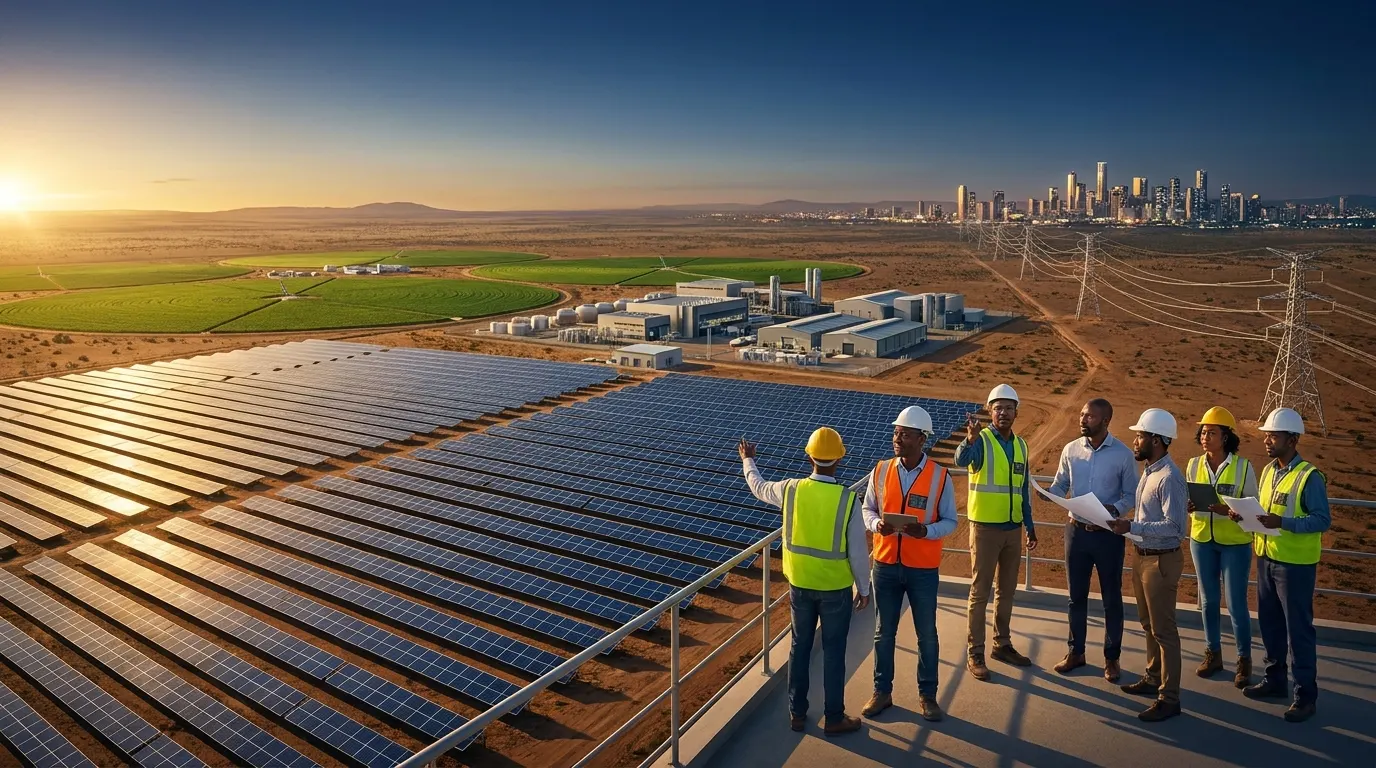
Responsibly developed solar infrastructure can support reliable electricity supply, industrial competitiveness, local employment and skills, grid diversification, and reduced exposure to fuel-price volatility. Every outcome must be planned, measured, and evaluated project by project — which is exactly how we approach it.
Insights
Thinking on African solar development
Bankability
What Makes an African Solar Project Bankable?
The eleven elements financiers actually test — and why most projects stall on three of them.
9 min read
Development Path
From Site Control to Financial Close: The Solar Development Path
The stage gates between a promising site and a financed project, and what each one must prove.
10 min read
Development Strategy
Why Grid, Offtake, and Permitting Must Advance Together
Sequencing errors quietly kill solar projects. How disciplined developers keep three workstreams aligned.
8 min read

Bring the right solar opportunity into development.
Whether you represent a government, utility, project owner, investor, lender, EPC, technology provider, landholder, or corporate offtaker — SmartWorld Power is ready to evaluate where a structured development partnership can create value.